MITSUBA Group disclosed information regarding climate change in November 2023 based on the recommendations of the Task Force on Climate-related Financial Disclosures (TCFD*1).
In order for MITSUBA Group to develop sustainably into the future, we believe that it is necessary to further promote management that incorporates a climate change perspective. Therefore, we established a TCFD Response Team under the ESG Committee, which analyzed the risks and opportunities related to climate change, and disclosed information on a four-item framework consisting of “Governance,” “Strategy,” “Risk Management,” and “Indicators and targets.”
Furthermore, we have declared our support for the TCFD recommendations and joined the TCFD Consortium (*2).
Going forward, we will continue to be aware of the business environment surrounding Mitsuba and group companies, deepen the analysis of risks and opportunities, utilize such analysis in the management strategies, and further promote measures to realize a carbon-neutral society.
*1 : TCFD refers to the Task Force on Climate-related Financial Disclosures, which was established by the Financial Stability Board at the request of the G20. The TCFD published its final report in June 2017, encouraging companies to disclose information about climate change-related risks and opportunities.
Currenty, the International Sustainability Standards Board (ISSB) has formulated the IFRS Sustainability Disclosure Standards, which incorporate the TCFD disclosure framework, and these standards are being used as the international standard for sustainability information disclosure.
*2 : The consortium was formed on May 27, 2019, to serve as a platform for discussing effective corporate information disclosure and linking this disclosed information to appropriate investment decisions by financial institutions and other organizations. The Ministry of Economy, Trade and Industry, the Financial Services Agency, and the Ministry of the Environment participate as observers.
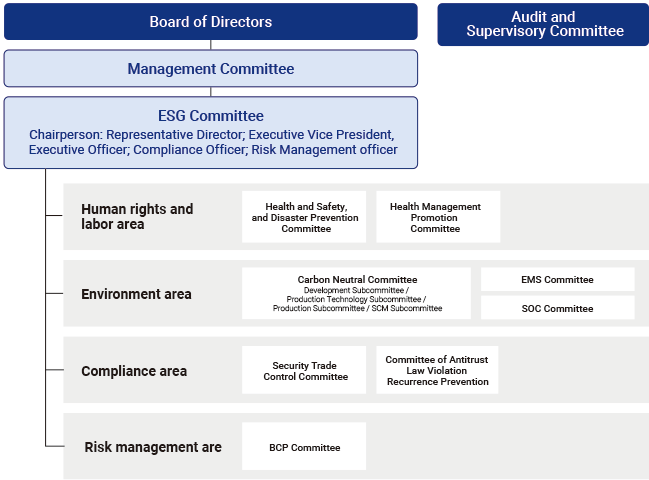
At MITSUBA group, the ESG Committee (chaired by the Representative Director, Executive Vice President), which is a business execution committee for CSR, sets social issues that the group should particularly focus on solving as priority issues, clarifies targets, and monitors progress four times a year. The matters discussed at the ESG Committee are reported to the Management meeting twice a year, and to the Board of Directors as necessary.
Regarding risk management, MITSUBA group regularly (once a year) identifies company-wide business risks, including climate change, at the ESG Committee and evaluates them based on frequency of occurrence and various degrees of impact. Furthermore, MITSUBA has established committees under the ESG Committee to resolve issues in each area.
In response to climate change, MITSUBA has established the Carbon Neutrality Committee (Chairperson: Representative Director, President) in FY2021 to establish the Mitsuba Group Carbon Neutrality Policy, and monitorCO2 emissions per product throughout its life cycle, and strive to understand and reduce total CO2 emissions throughout the supply chain.
Regarding environmental management, the EMS committee plays a central role in implementing environmental management and environmental conservation activities. Once a year, a review is conducted by the Executive Vice president and Executive Officer, who is the general environmental manager for the entire company, confirming the effectiveness and appropriateness of initiatives, and resolutions are made at the ESG Committee for projects that have a significant impact on management.
Regarding BCM (Business Continuity Management), MITSUBA has established an appropriate management system centered on the BCP Committee to fulfill the company's product supply obligations.
The TCFD recommendations set multiple climate change scenarios, analyze the actual and potential impacts of climate-related risks and opportunities on an organization's businesses, strategies, and financial plans, and provide countermeasures for each scenario to encourage demonstrating the resilience of their strategies. Mitsuba and group companies conducted an analysis presuming two scenarios as shown in the table below. The overview of each scenario and world view, as well as reference scenarios are as follows.
| Name | 1.5℃/2℃ scenario | 4℃ scenario |
|---|---|---|
| Overview of the scenario | ・A scenario in which temperature increase is limited to 1.5 °C / 2 °C above pre-industrial levels due to an accelerated transition towards a carbon-neutral society. ・Mainly the risk of transitioning to a carbon-neutral society emerges |
・A scenario in which global warming progresses and temperatures increase by 4 °C above pre-industrial levels if no measures are taken to achieve a carbon-neutral society that exceeds the current level. ・Mainly the physical risk due to climate change |
| Overview of the world view | ・Due to changes in policies, laws, and regulations aimed at transitioning to a carbon-neutral society, such as the introduction of carbon tax and the expansion of renewable energy, the response costs and additional investments from companies will increase. ・Electrification of the automobile and motorcycle markets is progressing rapidly, and customer preferences regarding mobility are also changing. |
・The introduction of policies, laws, and regulations aimed at transitioning to a carbon-neutral society is limited. ・Electrification of the automobile and motorcycle markets progressing to a certain extent, but progress is limited. ・As climate change progresses, changes in climate patterns and the intensification and frequency of abnormal weather conditions impact operations, increasing the importance of supply chain risk management and BCP reviews. |
| Main reference scenario | ・ IEA World Energy Outlook 2022, Announced Pledges Scenario (APS), Net Zero Emissions by 2050 Scenario (NZE) ・IPCC Sixth Assessment Report SSP1-2.6 |
・IEA World Energy Outlook 2022, Stated Policies Scenario (STEPS) ・IPCC Sixth Assessment Report SSP5-8.5 |
Based on the above scenario and taking into consideration the scenario analysis of the automobile industry and the recognition of the business environment in Mitsuba’s medium-term management plan (FY 2023 - 2027), we have identified and assessed the impact of the Mitsuba and group companies' anticipated climate change-related risks and opportunities, summarized in the table below. Among the identified risks and opportunities, the important items for Mitsuba and group companies are “Policies, laws, and regulations for transitioning to a carbon-neutral society (carbon pricing and energy)”, “Electrification of the automobile and motorcycle markets”, “Progress”, and “Physical risks such as abnormal weather conditions”, and below is a summary of those items.
| Important items | Risks | Time axis | Impact | Opportunities | Time axis | Impact | Mainly relevant scenario | |
|---|---|---|---|---|---|---|---|---|
| Policies and regulations for the transition to a carbon-neutral society | Carbon pricing | Increase in costs due to introduction of carbon tax / carbon border tax | Short term to Long term | Large | Reduction of business operation costs by switching to energy-efficient production equipment Reduction of business operation costs by streamlining production and logistics | Short term to Long term | Medium | 1.5℃/2℃ |
| Increase in purchasing and response costs due to increasing demands for CO2 reduction throughout the supply chain | Short term to Long term | Large | ||||||
| Energy | Increase in energy costs due to expansion of renewable energy in each country | Short term to Long term | Large | |||||
| Increase in response costs and additional investments due to development and introduction of energy-saving and renewable energy equipment, etc. | Short term to Long term | Large | ||||||
| Progress in electrification in the automobile and motorcycle markets (technology, market, reputation) | Decrease in ICE unit sales due to strengthening of fuel efficiency, ZEV regulations, etc., and decrease in product demand for ICEs | Short term to Long term | Large | Contribution to the reduction of vehicle weight, engine load, etc., to improve fuel efficiency and reduce CO2 emissions of ICEs | Short term to Long term | Large | 1.5℃/2℃ | |
| Decrease in sales due to inability to respond to changes in OEMs and consumers due to advances in CASE such as electrification | Short term to Long term | Large | Increase in electrification products aimed at providing value to users Improvement of added value products through electronic control of motors in line with the progresses of CASE |
Short term to Long term | Large | 1.5℃/2℃ | ||
| Expansion of new products that are lighter and more energy efficient due to carbon neutrality | Long term | Large | 1.5℃/2℃ | |||||
| Decline in preference and brand image from stakeholders such as investors, employees, and customers due to delays in response to a carbon-neutral society | Short term to Long term | Medium | Expansion of support among ESG investors, acquisition of talented human resources, and maintenance along with expansion of the customer base through effective stakeholder communication regarding contributions to carbon neutrality | Short term to Long term | Medium | 1.5℃/2℃ | ||
| Physical risks such as abnormal weather conditions | Damage to the head office / production sites and impact on operations due to abnormal weather conditions (heavy rain, flooding, etc.) | Long term | Large | Gaining of customer trust by ensuring stable supply in times of disasters | Long term | Medium | 4℃ | |
| Increase in response costs due to stoppages in the supply chain caused by abnormal weather conditions, including stoppages in production and sales, decline in sales, alternative purchasing of raw materials and parts, and the spread of a global pandemic caused by abnormal weather conditions | Long term | Large | ||||||
*Target for analysis: Mitsuba’s own domestic transportation equipment-related business, and Mitsuba affiliates’ overseas transportation equipment-related business (mainly in China and other Asian countries)
*Time axis: Short term -> until 2027 (period of Mitsuba and group companies’ "Medium-term Management Plan (2023 - 2027)"), Medium term -> until 2030, Long term -> until 2050
*Impact: Composed of three levels (large, medium, and small) considering the overall impact on the business of Mitsuba and group companies
For MITSUBA and group companies, we recognize that the “Development of electrification in the automobile and motorcycle markets” in particular has a significant impact on our business in terms of both risks and opportunities. In the short to medium term, our policy for responding to these risks and opportunities is to steadily respond to the needs for improved fuel efficiency and reduced CO₂ emissions of ICEs, which will be important during the transition period to electrification, and to withstand changes in the business environment. In addition to strengthening our financial base, we will actively invest in the development of new products for electric vehicles and implement sales expansion strategies such as customer diversification. In the long term, we will promote initiatives such as developing the product portfolio for electric vehicles into the core of sales and profits.
Regarding “Policies, laws, and regulations for the transition to a carbon-neutral society (carbon pricing and energy)” and "Physical risks such as abnormal weather conditions”, we are taking actions in consideration of the entire supply chain, as shown in the table below.
| Important items | Countermeasures | |
|---|---|---|
| Policies and regulations for the transition to a carbon-neutral society | Carbon pricing | [Reduction of CO2 emissions throughout the supply chain] ・Continue planned updates to energy-saving equipment. ・Continue improvement activities that go back to the start, from the stages of production equipment manufacturing and process design, such as electrification of equipment, reduction of heating processes, and utilization of recycled materials. ・Continue to actively promote the use of renewable energy (solar power generation, etc.). ・Expand the Environmental Management System (EMS) to the entire supply chain including suppliers. ・Promote initiatives across the entire supply chain management, including investigating CO2 emissions from suppliers and identifying reduction measures, as well as investigating and reducing CO2 emissions related to transportation between Group sites. |
| Energy | ||
| Development of electrification in the automobile and motorcycle markets | [Response to the needs for improved fuel efficiency and reduced CO2 emissions of ICEs, which will be important during the transition period to electrification] ・In the short to medium term, we will steadily respond to the needs for improved fuel efficiency and reduced CO2 emissions in automobile and motorcycle ICEs, support the transition process to a carbon-neutral society that varies by region, and strengthen our financial base by making our products highly profitable (“Automobile: Heat management system, chassis system (circulatory system, etc.)”, “Motorcycle: Engine auxiliary system”, etc.) with growth potential). ・In the motorcycle business, we are contributing to product needs for high-concentration ethanol vehicles and FFM vehicles (flexible fuel motorcycles), which are expected to be a precursor to ZEVs. [Development in sales expansion of new fields and new products in response to the progress of electrification] ・Contribute to the growing demand for motors through stable supply as the need for electronic control increases. ・Cultivate new markets by customizing existing product groups that do not rely on drive systems, which account for most of our business portfolio, for use in automotive and motorcycle electric vehicles. ・Accelerate the development and sales of high value-added products compatible with electrification, such as products for automotive electric vehicles (thermal management/ADAS/autonomous driving) through the electrification solutions business. ・Develop new EV/OEM markets in China and India. ・Products and services related to next-generation mobility compatible with MaaS. |
|
| Physical risks such as abnormal weather conditions | [Improvement of disaster countermeasures throughout the supply chain] ・Building and implementation of BCP (Business Continuity Plan) and BCM (Business Continuity Management) ・Capital investment in preparation for physical risks such as abnormal weather conditions (damage to head office and production sites, impact on operations, disruption of supply chains, etc.) ・Strengthening of the supply chain management ・Further promotion of health management measures such as employee health management and infectious disease prevention in response to pandemics caused by abnormal weather conditions. |
|
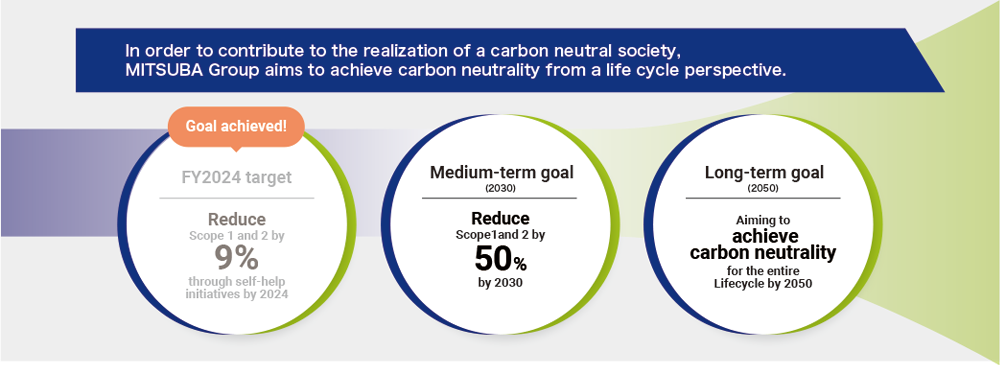
Based on the “MITSUBA Group Carbon Neutral Policy” (Figure 2), we aim to reduce CO2 emissions Scope 1 and Scope 2 by 50% compared to 2018 by 2030, and to achieve carbon neutrality throughout the entire life cycle by 2050.
The CO2 emissions results for the MITSUBA and group companies in FY2022 are 11,163t- CO2 in Scope 1, 136,214t- CO2 in Scope 2, and 1,074,241t- CO2 in Scope 3. We will disclose this every year using the MITSUBA Group Sustainability Report.
TCFD Report (1.7MB/11P)

 Search