MITSUBA also confirms the status of compliance with environmental laws and regulations at Group companies by periodically visiting and directly checking the sites to understand the daily operation and provide proper guidance. Moreover, in order to prevent violations of the laws and regulations, we directly check and provide guidance on regulations, work processes, equipment, and facilities related to the labeling, storage, handling, and transportation of hazardous materials, as well as the proper disposal of waste.
Regarding noise, we have implemented measures to reduce it, such as installing soundproof walls in some areas, and we also measure noise at the boundary of the site twice a year to continuously monitor it.
Regarding the MITSUBA R&D Center, where soil contamination with hexavalent chromium was discovered, we have reported the matter to the government and are working to take appropriate measures. Hexavalent chromium and cyanide concentrations in groundwater are measured once a year, but they have not been detected since 2018. Moreover, at the Tomioka Plant, where the soil and groundwater contamination due to tetrachloroethylene was found, we have voluntarily taken measures to prevent the spread of the contaminant after consulting with the government. The concentrations of tetrachloroethylene and its decomposition products in groundwater are measured twice a year, ensuring that these substances do not disperse beyond the site.
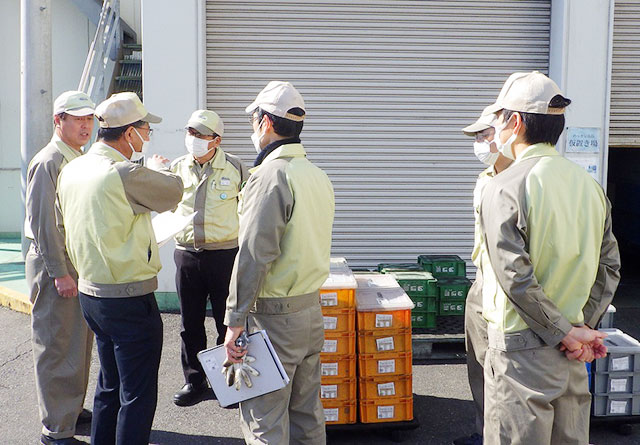
Training at Tatsumi
To prevent contaminated water from leaking from the plant, we have installed wastewater treatment equipment and oil-water separators, and in addition to thorough daily management, we also conduct measurements once a month to twice a year for continuous monitoring. Additionally, we conduct on-site training once a year in accordance with response procedures in the event of a spill accident.
In order to reduce the amount of dust and chemicals emitted into the atmosphere from our plants, we have installed dust collectors and exhaust gas treatment equipment. Mist collectors are installed in processes where oil mist is generated to collect the mist.
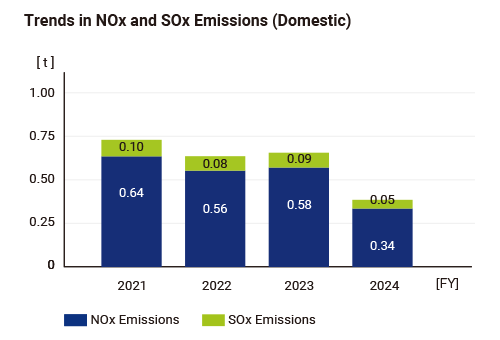
Moreover, chlorine and hydrogen chloride emitted from the plating facilities at the Niisato Plant are removed using scrubbers. We measure exhaust gas emissions at least twice a year, and have never detected any emissions, confirming that there are no problems. Furthermore, by switching the energy source for air conditioning used in domestic factories from kerosene to electricity, we are promoting the reduction of emissions of nitrogen oxides (NOx) and sulfur oxides (SOx), which cause air pollution.
With regard to chemical substances emitted from domestic business sites, we monitor the amount of substances designated under the Pollutant Release and Transfer Register law (*1) (PRTR system (*2)) and VOCs (*3) emitted and transferred, and are continually working to find alternatives to these chemical substances in order to reduce their emissions into the atmosphere.
*1 PRTR Law: It is the Act on Confirmation, etc. of Release Amounts of Specific Chemical Substances in the Environment and Promotion of Improvements to the Management
*2 PRTR: Abbreviation for Pollutant Release and Transfer Register. This system requires business operators to determine the amount of chemical substances that may be harmful to human health or the ecosystem that are released into the environment and transferred outside their business premises as part of waste, and report this to governmental authorities, who then compile and publish the amount of emissions and transfers based on estimates made using reports from business operators and statistical data.
*3 VOC: Abbreviation for Volatile Organic Compounds
We strive to prevent the leakage of fluorocarbons by thoroughly conducting simple and regular inspections, and we also strictly comply with laws regarding the rationalization of the use and proper management of fluorocarbons. Additionally, we regularly verify that the calculated leakage amount is less than 1,000 t-CO2 per year.
MITSUBA Group promptly reports to the Chief Environmental Officer (MITSUBA Head Office) in the event of an environmental non-compliance, and after taking emergency measures at the office where it occurred, the cause is investigated, and corrective measures are implemented.
The Chief Environmental Officer evaluates the effectiveness of the corrective measures implemented and instructs other Group companies to roll out the corrective measures horizontally.
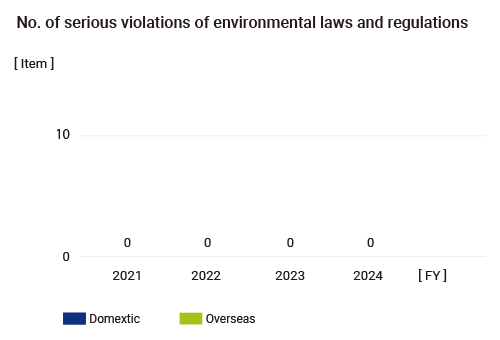
In FY 2024, the MITSUBA Group did not have any serious violations of environmental laws and regulations.

 Search