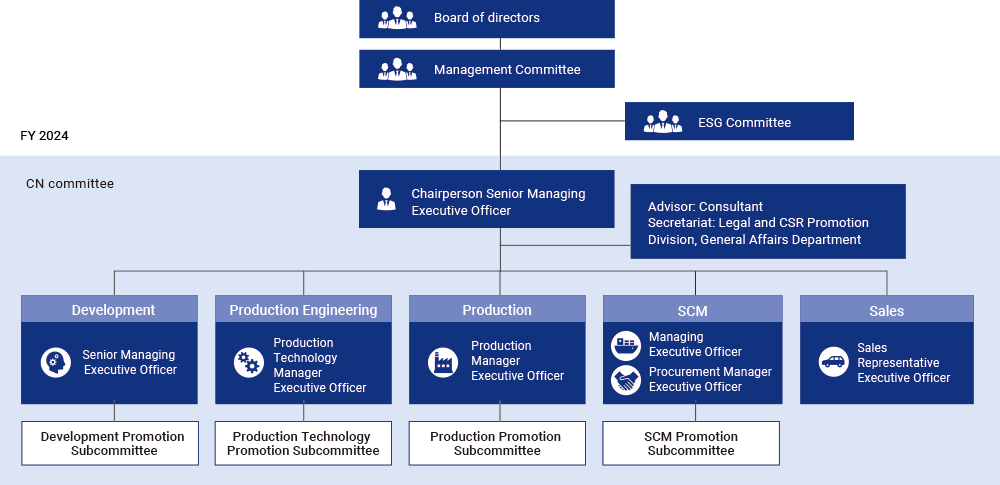
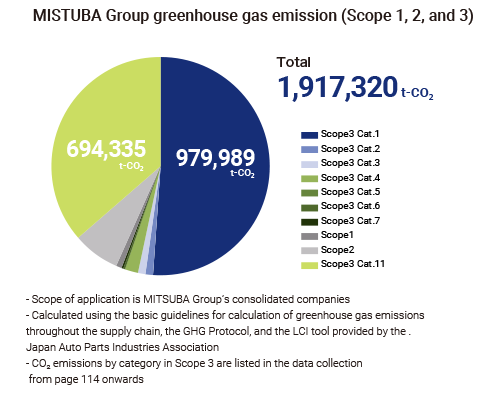
MITSUBA Group has steadily reduced CO2 emissions within the Group until today. However, in order to contribute to achieving carbon neutrality, it is necessary for the entire supply chain to work together to understand and reduce the CO2 emissions that are emitted directly and indirectly through business activities from a product lifecycle perspective. From FY 2021, we established the Carbon Neutrality Committee, chaired by the President and CEO, and directly under it we established promotion subcommittees covering the areas of Development, Production Engineering, Production, and SCM (Supply Chain Management). In FY 2024, under a new structure that also includes the sales domain, we will expand our focus from the traditional reduction of Group CO2 emissions to include material procurement, the transportation of products and parts, and even the product usage stage, as we take on the challenge of reducing CO2 emissions throughout the entire supply chain.
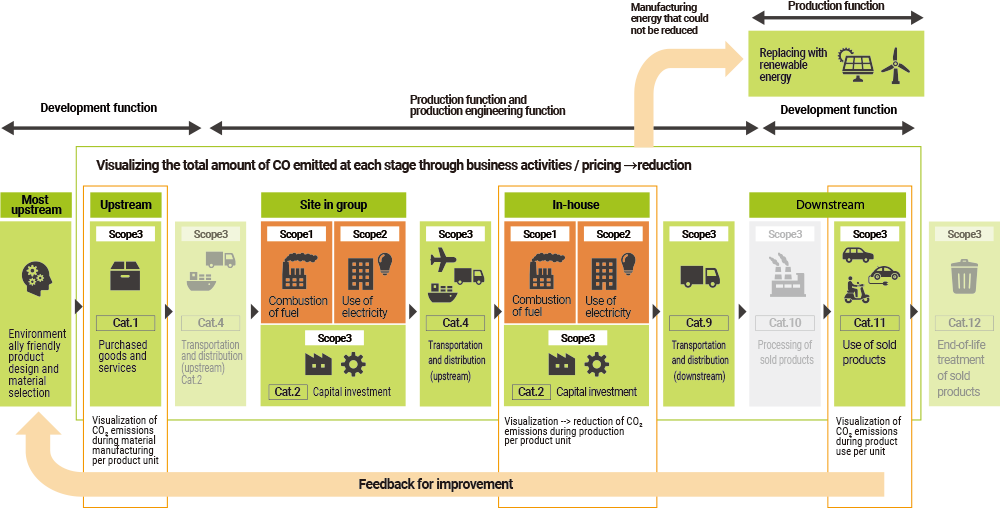
In order to achieve carbon neutrality, it is necessary to reduce CO2 emissions throughout the entire supply chain by expanding the scope of initiatives from materials procurement to transportation of products and parts, as well as the usage and disposal of products. Moreover, the visualization of CO2 emissions per product and the provision of this information to the most upstream (development function) can be expected to lead to further improvements in environment-conscious design and material selection.
Carbon Neutral Topics
Achieving the “MITSUBA Group Carbon Neutrality Policy” requires the cooperation of all employees within the Group. We are also striving to raise awareness by creating a dedicated in-house homepage, creating educational videos, and regularly distributing “Carbon-neutral Topics,” which summarizes information on external trends and initiatives within the Group.
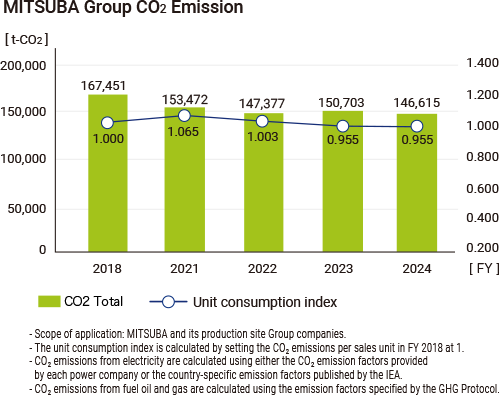
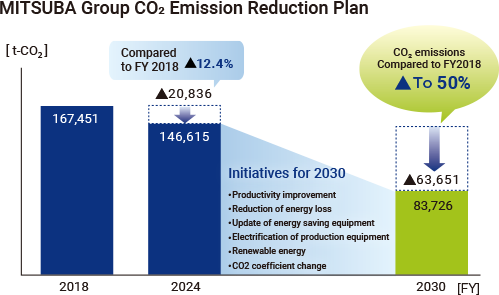
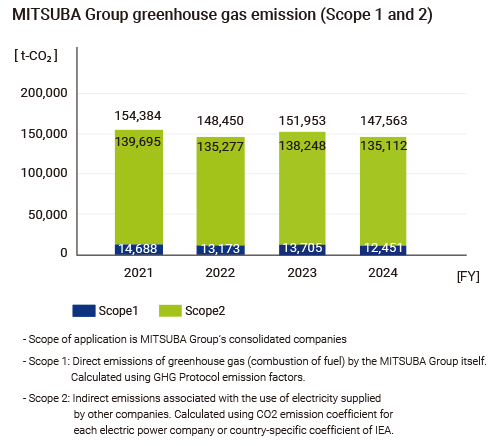
To achieve our goal of reducing Scope 1 and 2 (Group CO2 emissions) from production activities by 50% by 2030 compared to FY 2018, we are developing reduction plans and roadmaps, striving for high-efficiency production and advancing production engineering capabilities, while also promoting the introduction of renewable energy.
In FY 2024, we have steadily implemented measures equivalent to a 13.2% reduction, against the planned target of a 9% annual reduction. These initiatives not only reduced CO2 emissions but also helped reduce soaring energy costs.
MITSUBA Group has introduced an internal carbon pricing system from FY 2024 to promote capital investment aimed at reducing CO2 emissions. This system makes it possible to visualize the economic impact of updating aging equipment and improving energy efficiency, leading to more appropriate investment decisions.
MITSUBA Group has formulated a group policy to achieve both CO2 emission reduction and economic growth, with the aim of introducing renewable energy equivalent to 10,000 t-CO2 by 2030. In FY 2024, solar power generation systems using an on-site PPA model began operating at affiliated companies in Vietnam and Thailand, bringing the total amount of electricity generated from renewable energy sources across the Group to 7,660 MWh per year. We will continue to actively promote the introduction of renewable energy sources suited to the characteristics of each region and work to expand the use of sustainable energy.
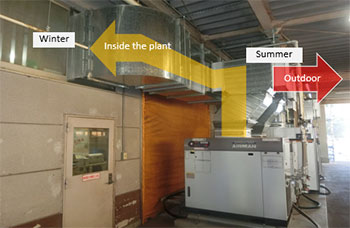
Efficient use of compressor exhaust heat
As part of its initiatives to become carbon neutral, the Fukushima Plant is identifying issues and working to make improvements from the six key perspectives: “Fix, Stop, Halt, Lower, Pick-up, Return."
From a “Pick-up" perspective, we are considering how to effectively utilize exhaust heat in conjunction with the relocation of the compressor room, thereby mitigating the air conditioning load, which is at its highest in winter. By reducing electricity and kerosene consumption for heating, we have achieved an annual reduction of 118.1 t-CO2 and improved the working environment for employees.
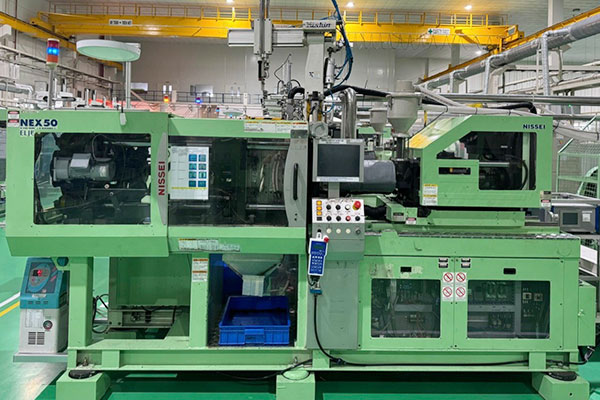
Injection molding machine using
low pressure molding technology
At the Loteco Plant of MITSUBA Vietnam, various improvement activities were implemented, including downsizing the injection molding machine, reducing the air pressure supplied to the resin dryer, and reducing the amount of unnecessary resin (trial shots) generated at the start of molding.
In our injection molding workplace, we utilize low-pressure molding technology and carefully determine molding conditions based on the product area and material fluidity. As a result, we successfully utilized the existing 50-ton equipment, avoiding the need to install a new 110-ton injection molding machine. This led to a reduction of 63.6 t-CO2 per year and minimized capital investment costs.
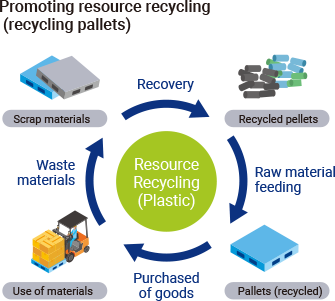
The Logistics Section of MITSUBA Supply Chain Management Department is promoting the use of recycled pallets by utilizing discarded plastic pallets used by the MITSUBA Group. Moreover, by making effective use of plastic packaging materials and paper trays, we have achieved an annual reduction of 63 t-CO2 and contributed to reducing material purchasing costs. Moreover, we are working to further reduce CO2 emissions during the transportation of products and parts by visualizing trends in CO2 emissions by transportation mode, such as truck, rail, ship, and air, at each stage of procurement, production, and sales logistics. We repeatedly identify and examine issues and formulate transportation policies each area.
MITSUBA Group undergoes third-party verification by SGS Japan Inc. with the aim of improving the transparency and reliability of environmental performance data such as Scope 1 and 2 CO2 emissions and water intake. Going forward, we will continue to work on improving data accuracy and continuous improvement while gradually expanding the scope of verification.

 Search