Due to the recent growing interest in environmental issues, regulations regarding hazardous chemical substances are becoming stricter every year around the world. Last year, there was a movement to restrict Medium-Chain Chlorinated Paraffins (MCCP), and there has been active discussion, particularly in Europe and the United States about restricting Perfluoroalkyl and Polyfluoroalkyl Substances (PFAS), which are widely used in everyday products. The MITSUBA Group states in the MITSUBA environmental declaration that it will"strive to reduce pollution and properly dispose of it." In order to comply with strengthened laws and regulations in each country and region, such as the POPs Convention (*1), the European ELV Directive (*2), the European REACH Regulation (*3), the U.S. TSCA Regulation (*4), and the Chemical Substances Control Law (*5), the MITSUBA Group is actively working to properly manage chemical substances and eliminate the use of hazardous chemicals, including those used in products.
(*1) POPs Convention: Stipulates the elimination and restriction of the production and use of Persistent Organic Pollutants (POPs)
(*2) European ELV Directive: A directive to reduce the environmental impact of end-of-life vehicles, stipulating restrictions on the use of lead, mercury, cadmium, hexavalent chromium, etc.
(*3) European REACH Regulation: Regulation on the registration, evaluation, authorization, and restriction of chemicals for the protection of human health and the environment.
(*4) U.S. TSCA Regulation: Toxic Substances Control Act. Law concerning the control of chemical substances and mixtures that pose an unreasonable risk to human health or environment.
(*5) Chemical Substances Control Law (Act on the Examination of Chemical Substances and Regulation of Their Manufacture, etc.): A law aimed at preventing environmental pollution by chemical substances that may harm human health and the growth of animals and plants.
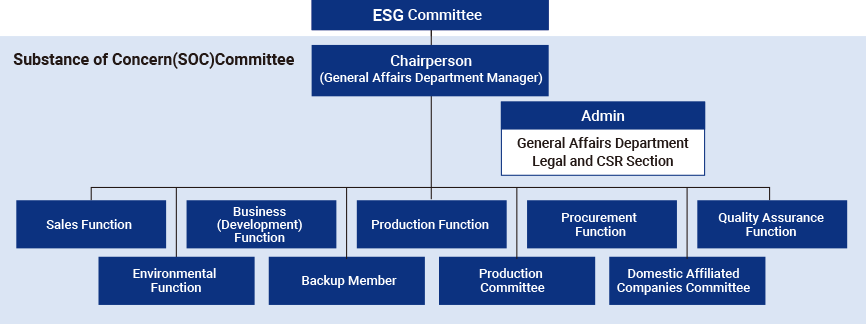
MITSUBA has established the SOC Committee as a system to monitor environmental laws and regulations, customer requirements, and industry trends related to its products, and to formulate and promote a Group switching policy to reduce or phase out hazardous substances in products to comply with regulations. This allows us to share information across departments and work towards achieving our goals.
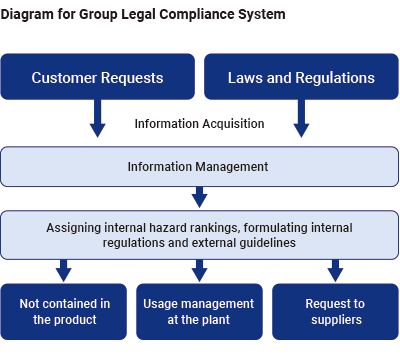
MITSUBA has established a global system to monitor the presence of hazardous chemical substances in products and to promptly submit various data, such as IMDS (*6) and JAPIA sheets (*7) when requested by customers. Moreover, we appropriately conduct investigations of management systems, responses to customer audits, etc.
In order to comply with product regulations, MITSUBA has strictly controlled each stage of development, production, and logistics, but the cooperation of our suppliers is essential. MITSUBA also requires its suppliers to thoroughly manage their products based on the “MITSUBA Substance of Concern List” which adds industry standards (GADSL *8) with individual customer requirements, as well as the "Group Green Procurement Guidelines."
(*6) IMDS: Online system for investigating chemical substances contained in parts and materials of automobiles, etc., and confirming compliance with the regulations of finished vehicles.
(*7) JAPIA sheet: Format created by JAMA (Japan Automobile Manufacturers Association) and JAPIA (Japan Auto Parts Industries Association) to register material components contained in products.
(*8) GADSL: List of prohibited and declared substances agreed upon by European, American, and Japanese automobile manufacturers.
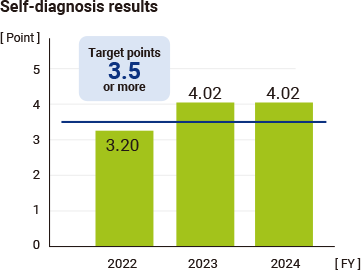
MITSUBA has utilized a self-diagnosis sheet (*9) to evaluate and quantify its management response capabilities, identify areas for improvement, and develop measures to make such improvements. Specifically, we have promoted measures such as establishing a system to check compliance with laws and regulations at the appropriate time for new parts and parts with changed materials, strengthening the system for managing the window for accepting customer requests, clarifying audit procedures for suppliers, maintaining and enhancing procedure manual for submitting IMDS data, and institutionalizing education, which has resulted in a significant increase in the number of points in FY 2023. For FY 2024, we have improved and set out the JAMA / JAPIA Guidelines for the Management of Chemical Substances in Products (*10).
(*9) Self-diagnosis sheet:
A tool for industry standard for self-evaluating the actual status of self-implementation of the management items specified in the JAMA / JAPIA Guidelines for the Chemical Substances Management in Products (*10) on a 5-point scale.
(*10) JAMA / JAPIA Guidelines for the Chemical Substances Management in Products : Guidelines for industry standard established by the Japan Automobile Manufacturers Association (JAMA) and the Japan Auto Parts Industries Association (JAPIA) to ensure proper management of chemical substances contained in products across the entire automotive industry.
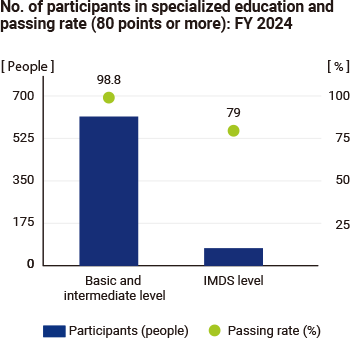
At MITSUBA, we plan and implement general and specialized education for development, sales, purchasing, and quality departments in order to further strengthen our management system for SOC. The specialized education consists of three parts: Beginner level, intermediate level, and IMDS level. The content of the education is extensive, and a system has been established to allow employees at different levels and in different roles to take the appropriate courses.
In FY 2024, we worked towards further improvement in understanding by developing a test function with explanations and managing pass rates.
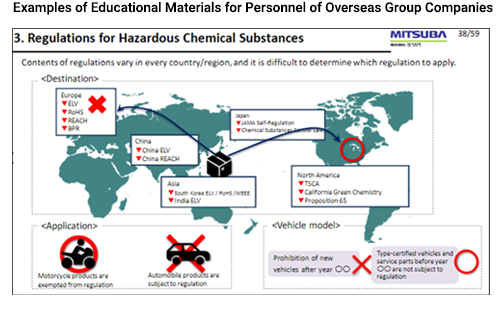
Moreover, we distribute educational videos so that the personnel at overseas Group companies can also take the course. Furthermore, we have set up a help desk in Japan for MITSUBA overseas Group companies to provide individual education on how to determine whether contained substances comply with regulations, how to submit IMDS data to customers, etc., when necessary.
IWhen the IMDS system is revised, we provide timely education to keep up with the changes, such as informing employees of changes and precautions.
Through this education, employees are able to have a personal responsibility and acquire necessary knowledge with SOC management, accelerating their efforts to achieve and maintain compliance with laws and regulations across the Group.
The MITSUBA Group has established group standards for IMDS, and is standardizing rules for building an IMDS data registration system, confidentiality management, data creation and checking, and escalation when problems occur.
This allows us to manage IMDS data appropriately across the entire group, prevent data returns from customers, and ensure compliance with customer’s data submission deadlines.
MITSUBA participated in the “Industry Standard Check Sheet TF” for the Chemical Substance Management in Products, led by the Japan Automobile Manufacturers Association and Japan Auto Parts Industries Association, and contributed to industry activities regarding the creation of a self-diagnosis sheet. Through this activity, we gained a deeper understanding about the management standards of the industry. By utilizing this tool, we are working to improve the efficiency of our management system throughout the supply chain.
Moreover, we cooperate in investigating the impact of the legislation on additional prohibited substances in various countries on the automotive industry, and contribute to public relations activities regarding laws and regulations that do not interrupt social activities.
MITSUBA verifies the results of self-diagnosis sheets and provides guidance for improvements to quality-related personnel at Group companies in order to strengthen its management system.
For suppliers whose management systems need to be checked, we ask them to complete a self-evaluation using a self-diagnosis sheet, and then we conduct a management system audit based on its results to confirm that there are no problems. In FY 2024, we conducted an online audit of one company, requested and implemented corrective measures, and asked for their cooperation in further strengthening and improving the management system.
Moreover, with the cooperation of our rubber parts suppliers, we conduct on-site inspections and carry out interviews and information exchanges regarding the status of chemical substance management in products, and we continue to improve shared understanding through collaboration.

 Search