MITSUBA aligns itself with international norms such as the UN “International Bill of Human Rights” and “Guiding Principles on Business and Human Rights”, the OECD “Guidelines for Multinational Enterprises”, and the ILO “Declaration on Fundamental Principles and Rights at Work” and “Tripartite Declaration of Principles concerning Multinational Enterprises and Social Policy”. These frameworks guide our Group-wide human rights policy.
Based on our Mission Statement— “Mitsuba will provide pleasure and peace of mind to the people of the world”—we comply with relevant international laws and national regulations, uphold diversity, and respect internationally recognized human rights.
MITSUBA promotes respect for human rights across all domestic and overseas business activities, including Group companies.Given the nature of our business, collaboration with diverse suppliers is essential. Therefore, we strive to ensure that respect for human rights is upheld throughout our entire supply chain.We also request the understanding and cooperation of our suppliers as we advance these efforts.
1) Prohibition of Discrimination and Harassment
MITSUBA does not tolerate discrimination based on birth, nationality, creed, religion, gender, race, ethnicity, age, disability (mental or physical), medical history, hobbies, educational background, or social status.We explicitly reject all forms of workplace harassment, including power harassment, sexual harassment, and maternity harassment.
In employment practices, we ensure that decisions related to hiring, treatment, evaluation, and compensation are not made on the basis of factors unrelated to an individual’s aptitude or capability—such as “conditions beyond the individual’s control” or “matters that should remain private.” For recruitment in particular, we hold regular briefing sessions for interviewers to promote fair hiring practices and deepen internal understanding.
2) Prohibition of Child Labor and Forced Labor
MITSUBA recruits and employs individuals in compliance with relevant international and national laws, and does not permit child labor or forced labor. We also monitor risks within our supply chain and take corrective action in collaboration with business partners when issues are identified.
3) Labor Standards and Working Environment
MITSUBA complies with labor standards, including working hours and wages, in accordance with applicable laws and regulations at the national as well as local and regional levels. To foster a healthy and balanced working environment, we promote appropriate workload management and flexible workstyles that support work–life balance.
4) Occupational Health and Safety
MITSUBA prioritizes a safe workplace environment above all else and operates our occupational health and safety management based on legal compliance. In addition to preventing workplace accidents and incidents, we continuously strengthen initiatives that support employee health and well-being.
5) Prevention of Human Rights Violations in the Supply Chain
MITSUBA works with suppliers through dialogue and support to drive improvement when human rights violations or potential risks are identified within the supply chain. We also maintain mechanisms that allow external stakeholders to raise concerns or report issues anonymously by phone, email, or postal mail. All reports are handled promptly and fairly.
6) Freedom of Association and Collective Bargaining
MITSUBA recognizes collective bargaining as a fundamental human right. Our labor agreements acknowledge employees’ rights to engage in collective bargaining on matters such as wages and working conditions.Through the union shop system, we maintain an appropriate number of union members and ensure the effective functioning of collective bargaining. Whenever significant changes affecting employees’ working arrangements or employment conditions are proposed, we hold prior discussions between labor and management and implement measures only after reaching agreement.
In addition, we facilitate mutual understanding between management and employees through regular forums such as the Company-wide Management Council, divisional councils, labor–management committees, and direct dialogue opportunities internally referred to as the “Kuruma-za.”
7) Promotion of Diversity
MITSUBA continues to advance the hiring, development, and workplace inclusion of diverse talent, including women, foreign nationals, and persons with disabilities. To leverage employee diversity in both business activities and cultural transformation, we will further strengthen career development programs and workstyle reforms.
8) Health and Well‑Being Promotion
MITSUBA believes that creating an environment where each employee can work energetically and build a fulfilling life is essential. To this end, we promote initiatives that support both physical and mental well-being, as well as workplace systems that provide security during life events such as marriage, childbirth, injury, or illness.
MITSUBA provides CSR education—including harassment-related topics—through e-learning for all employees. We also conduct annual “Human Resources and Labor Briefings” for managers, focusing on harassment prevention and related issues. Educational content is reviewed annually to reflect changes in societal expectations. By sustaining manager and employee education, we work to deepen human rights awareness across the Group.
MITSUBA values the perspectives of a wide range of stakeholders—including government agencies, financial institutions, investors, rating organizations, and local communities—on matters related to human rights. We gather external feedback through channels such as the General Meeting of Shareholders and inquiry points, and we incorporate these insights into our business management. For the supply chain, we promote human rights respect through both regular and ad hoc assessments, as well as contractual commitments. Anonymous reporting channels are available to suppliers in the same manner as for internal stakeholders.
MITSUBA transparently communicates its human rights initiatives and performance through sustainability reports, various disclosures, and the corporate website. We place high importance on transparency, reliability, and accountability to society.
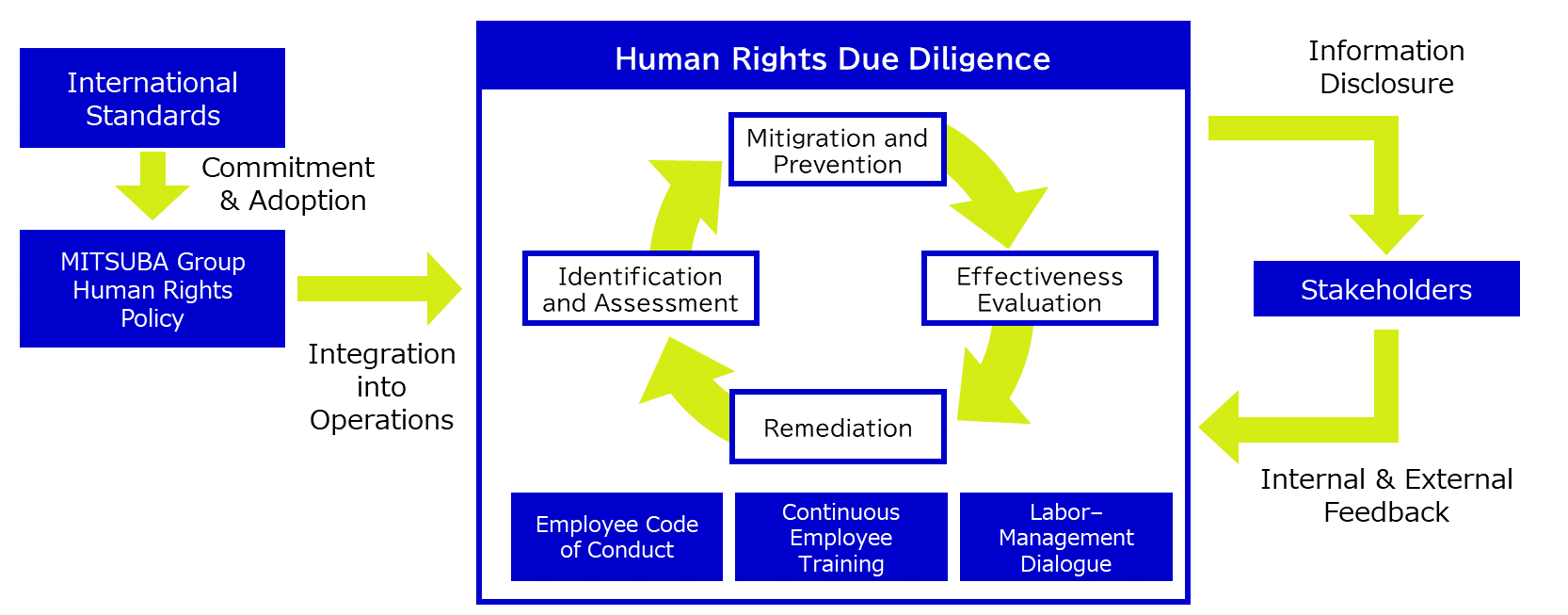
1) Identification and Assessment of Human Rights Risks
• Conduct regular assessments of human rights risks within the MITSUBA Group and across the supply chain
• Strengthen risk management systems by monitoring external developments and regulatory trends
• Adjust and prioritize measures based on risk and urgency
| Target | Domestic and overseas Group companies (34 companies) |
|---|
| Recovery rate | FY 2024: 100% |
|---|
2) Mitigation and Prevention
• Implement mitigation and preventive actions for identified risks
• Collaborate with suppliers to provide guidance and support as needed
3) Effectiveness Evaluation
• Regularly review and update KPIs
• Confirm sustainability of impact and prevent recurrence
• Incorporate insights from external experts and internal/external feedback
4) Remediation
• Take prompt corrective action and implement recurrence prevention measures when human rights violations are identified
• Utilize internal and external reporting mechanisms, including anonymous reporting
• Consider appropriate remedies based on the affected stakeholders (employees, suppliers, local communities, etc.)
At Mitsuba, we uphold respect for human rights in our code of conduct, the “How We Should Act”. This commitment extends not only to Group employees but to society as a whole. Through these efforts, MITSUBA aims to remain a company trusted by the international community.
To support the financial well-being and health of our employees, we provide a wide range of welfare programs for all employees, including an employee stock ownership plan, mutual aid association benefits, company-administered influenza vaccinations and vaccination subsidies, long-service awards (including special leave and monetary awards), reduced working hours and nursing care leave for children, as well as expanded eligibility for these programs. Through these initiatives, we strive to support employees' financial stability, maintain their health, and ensure their safety.

 Search