MITSUBA Group positions risk management as an important management issue in achieving its Mission Statement, which is its sustainability policy and aiming for sustainable growth and stability. In order to minimize diverse risks, such as large-scale earthquakes and other natural disasters, spread of infectious diseases, and geopolitical risks, we are committed in enhancing and strengthening our comprehensive risk management.
The MITSUBA Group has established the “Group Compliance and Risk Management Regulations,” which specify the basic matters regarding risk management within the company, in order address potential crises during both normal operations and emergencies. Risk management based on a continuous PDCA cycle is carried out through the ESG Committee, chaired by the Representative Director (Executive Vice President), who also serve as the Risk Management Officers.
ミBased on the “Group Compliance and Risk Management Regulations”, the MITSUBA Group periodically (once a year) identifies “business risks” related to changing social and environmental issues and evaluates them based on the possibility of occurrence and various degrees of impact. Moreover, we clarify the departments and committees responsible for these risks, plan mitigation measures and instruct their implementation, as well as identify important risks at the ESG Committee and disclose them externally through Asset Securities Reports (*) and other documents.
The MITSUBA Group views the formulation of Business Continuity Plan (BCP) as a priority theme in order to fulfill its obligation to supply products as a company. Therefore, we have established the BCP Committee under the ESG Committee, a company-wide committee, to develop an appropriate management system and disaster mitigation measures. Moreover, to enhance the effectiveness of BCP, we have established Group Business Continuity Management (BCM) regulations and are appropriately promoting BCM.
Furthermore, we have set up a “Production and Sales Committee” as an organization to handle risks from product production to sales and will identify risks and implement necessary measures from the perspective of stable product supply and disaster prevention.
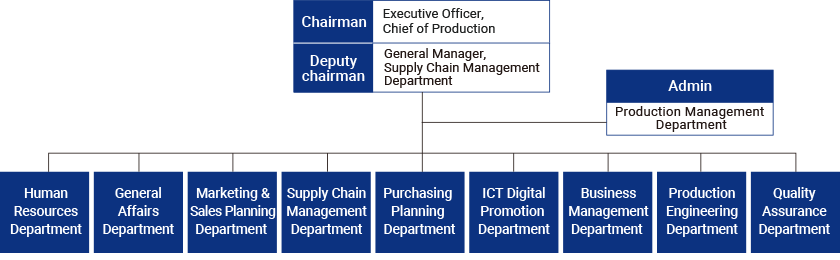
MITSUBA has established a BCP Basic Policy and developed a BCP in order to fulfill its responsibility to supply customers even in the event of an emergency such as major earthquake. Moreover, in FY 2020, we established a BCP Committee chaired by the Executive Officer in charge of Production and are working to improve and strengthen our BCP.
Furthermore, we have established working groups to develop systems to ensure the safety of employees in emergency situations such as disasters, fire prevention and disaster mitigation to minimize damage, and working on considering and implementing proactive measures to address global risks and risks in the supply chain.
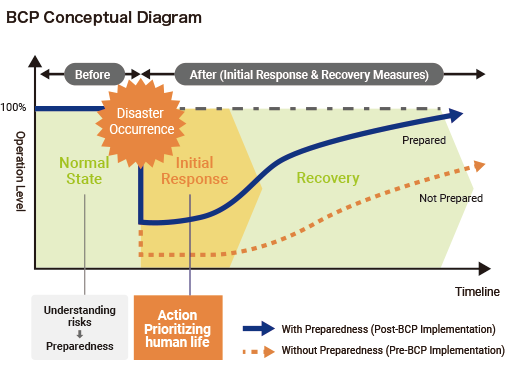
1. In the event of a disaster or other emergency, we shall prioritize the safety of our employees and their families.
2. We shall take preventative measures daily to minimize damage.
3. We shall fulfill our responsibility to supply to our customers by working to ensure business continuity and restore production activities as quickly as possible.
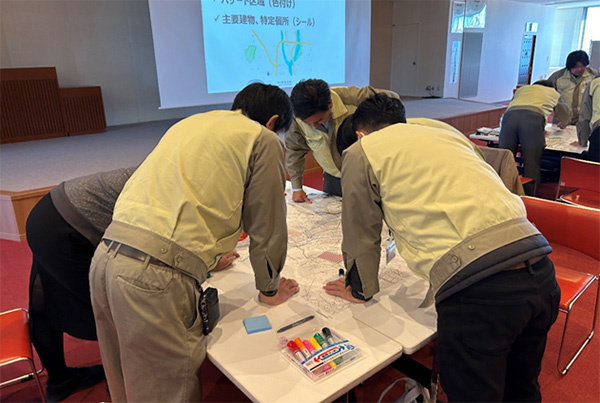
Training session
MITSUBA will further develop the activities that it has been working on up to FY 2023, and is currently transitioning to promoting activities in a holistic manner based on its basic policy.
Specifically, DIG (Disaster Imagination Game) will be conducted at each site, and based on the insights gained from the disaster map, managers of each site will discuss and promote measures that are appropriate for the characteristics of the site.
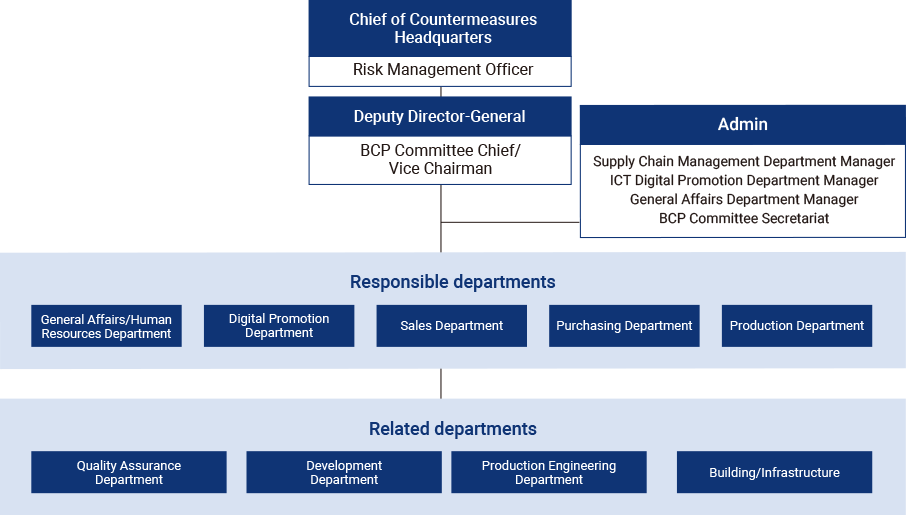
At MITSUBA, if it is determined that an emergency situation that could affect the supply of products to customers has occurred, the Risk Management Officer will activate the BCP and establish a disaster response headquarters. Under the direction of the Chief of the Disaster-response Headquarters, the departments in charge and related departments work together to ensure a swift response.
Based on the Group BCM regulations, the MITSUBA Group has formulated BCP Action Guidelines for procurement functions to ensure business continuity with our suppliers.
The main initiatives based on the Action Guidelines are as follows:
We are focusing on the following points to prepare for disaster risks and emergencies such as natural disasters, incidents, and accidents, to ensure business continuity, and minimize the impact on our suppliers.
Countermeasure: To prepare for risks, we voluntarily check and update our supply chain list on a regular basis.
| Response Rate (FY 2024) |
98 % |
|---|
Training: We regularly conduct in-house training to raise employee awareness and improve their response capabilities.
Information sharing: We work closely with suppliers to strengthen information sharing in the event of a disaster.
These efforts ensure smooth business continuity and information sharing even in the unlikely event of an emergency.

 Search